
Covington Records by Custodian
Open access depends on the record, not merely on whether a government office created it. Covington has no recorder of deeds, probate court, or vital-record office. City staff keep council, board, contract, planning, permit, and administrative files. King County and Washington agencies keep most long-term name records. The fastest first move is to identify the record set, its legal keeper, and whether an index is only a finding aid.
| Record set | Keeper | Web coverage | Ways to obtain it |
|---|---|---|---|
| Deeds, liens, plats, marriages | King County Recorder | Landmark index from 1976; most images from August 1, 1991 | Free index and watermarked view; paid copy online, by phone, mail, or counter; Archives microfilm for older material |
| Parcel and assessment rolls | King County Assessor and GIS | Current eReal and Parcel Viewer reports | Free web report; agency request for a certified product |
| Superior and district court cases | Clerk of the court of record | Statewide reference index; KC Script for many Superior Court documents | Portal, clerk counter, mail, email request, or archive retrieval |
| Birth and death certificates | King County Vital Statistics or Washington DOH | No unrestricted modern certificate index | Qualified order with ID and proof; historical Archives route |
| Jail, DOC, and offender records | King County DAJD, Washington DOC, WASPC | Current public lookups within each agency’s scope | Free lookup, then custodian or court confirmation |
| City permits, contracts, boards | Covington City Clerk or Community Development | Published files, Citizens Connect, and NextRequest | Online request, written form, email, fax, mail, or counter |
Some records remain closed or partly redacted. Sealed cases, juvenile and adoption files, protected personal identifiers, victim or active-investigation material, Address Confidentiality Program data, and controlled vital certificates have their own rules. A custodian should release segregable nonexempt portions when a file mixes open and exempt content.
Covington Deeds in Landmark
The Landmark Records Search is the county index for deeds, deeds of trust, releases, liens, plats, surveys, covenants, easements, marriage returns, powers of attorney, and other recorded instruments. A grantor transfers an interest; a grantee receives it. Search names as last name, comma, first name, and try Starts With or Contains when spelling or indexing may differ.
| Search control | Input | Practical detail |
|---|---|---|
| Mode | Name, document, book/page, parcel, date, recording number, legal, Torrens, quick search | Choose the narrowest known identifier |
| Party role | Both, grantor, grantee | Use Both if the person’s role is unknown |
| Name and match type | Last name, First name; Starts With, Contains, Equals | Reduce criteria when an exact form fails |
| Document filter | Type or broad category | Separate deeds, liens, plats, judgments, and releases |
| Date range | Begin and end dates | Shortcuts cover the last 7, 30, or 90 days |
| Legal and parcel | Description or first ten parcel digits | Parcel-mode results reach only 1997 to current |
A result can show the recording number and date, document type, named parties, legal description, parcel number when indexed, consideration when supplied, book/page or Torrens details, and an image link. These are index facts, not a title opinion. Reapply sorting or filters on each results page. Parcel indexing was not consistent until about 2002, so a party-name search can recover records that a parcel query misses.
Covington’s Three Land-Record Eras
King County’s public records form a useful timeline. The Archives holdings begin in 1853. The County Auditor managed recordings through 1969, and the Recorder took over in 1970. General Recordings grantor/grantee microfilm covers 1853 through 1975. Landmark begins in 1976, but most viewable images begin on August 1, 1991.
| Years | Primary route |
|---|---|
| 1853 to 1975 | Physical name/date indexes and microfilm at King County Archives |
| 1976 to July 31, 1991 | Find the index row in Landmark, then use its instrument number for Archives |
| August 1, 1991 to present | Landmark index and most images, with official copies from Recorder |
This split is more useful than a vague claim that records are online. A 1976 to 1991 row may supply the exact instrument number even when no image appears. Archives accepts a full party name and a year or five-year range; a parcel, legal description, or recording number makes the request stronger. A post-1991 deed may also cite an older easement, though that shortcut is incomplete.
Note: Recording numbers identify documents; ten-digit parcel numbers identify tax parcels, and the two should never be interchanged on a copy request.
Covington Property Records and GIS
eReal Property searches by parcel or tax account, site address, or property and condominium name. It has no owner-name input. Once a parcel is found, the report may show taxpayer name, situs address, jurisdiction, present use, levy code, assessed value, building and lot facts, and sale references. A situs address is the physical site. It is different from a taxpayer mailing address and from the deed’s legal description.
The King County Parcel Viewer accepts an address or parcel number and also supports map selection. It links selected land to eReal and district or development-condition reports. Those reports matter in Covington because a 98042 mailing label does not prove that a parcel lies inside city limits. City Community Development holds municipal permit files; county offices may hold older or unincorporated permits.
Assessment data does not prove title or occupancy. Recorder instruments establish conveyances. Treasury tax-account data follows a separate route and may show a mailing address only after an account is known. That address can support research, but it does not establish where a taxpayer lives.
Covington Court Indexes and Files
Covington contracts limited-jurisdiction court service to King County District Court. King County Superior Court handles felony, probate, guardianship, family, juvenile, and higher-level civil matters. The Washington Online Case Search can locate a person or case by party name, case number, court or location, type, and filing date. Its results may show the caption, parties, court, filing date, case type, and status references.
The statewide system updates daily, but it is reference data rather than the official case file. Use the case number to approach the named court. KC Script provides many Superior Court documents and audio records, while exhibits or older material may still require the clerk. Cases before July 1, 1979 may need microfilm or archive retrieval.
- Index
- A finding aid that points to a record but may not contain the filed document.
- Custodian
- The office legally responsible for keeping and releasing the record.
- Certified copy
- A copy carrying the custodian’s official certification or seal.
- Exemption
- A law or rule permitting specific information to be withheld or redacted.
A case-name hit does not establish that two people with a shared name are the same person. Compare middle names, dates, court, case number, role, and disposition. An allegation is not a finding.
Covington Vital Record Access
Washington’s Vital Records Act, chapter 70.58A RCW, controls certificates. King County Vital Statistics issues Washington births registered from 1907 forward and King County deaths within its stated year coverage. The Washington Department of Health handles statewide birth, death, marriage, and divorce certificate products. Recent birth and death certificates are qualification-controlled, not open merely because a government office holds them.
RCW 70.58A.530 sets qualified-applicant rules for certified copies, and RCW 70.58A.560 governs informational copies. The latter are nonlegal products. Under RCW 70.58A.510, birth and fetal-death records transfer to Archives after 100 years; death, marriage, and divorce records transfer after 25 years. Archive transfer timing does not cancel qualification rules for a record still held by the vital system.
A DOH mail certificate starts at $25. Contracted online or phone ordering starts at $40.50 before an optional identity-quiz charge. Certified orders require event facts, valid ID, and proof of a qualifying relationship where applicable. Mail, online, phone, and local counter or kiosk channels have different total costs and processing times, so check the current product route before ordering.
Covington Custody and License Records
Several statewide systems expose narrow public records rather than complete profiles. The King County JILS covers current and recent adult detention. Washington DOC covers people within state custody or supervision. The WASPC offender search has public-safety limits. A booking is not a conviction, and a jail result can change after release or transfer. Confirm any charge and outcome with the court of record.
The Washington DOL License Lookup searches regulated occupations by individual or business name, license number, type, and location where offered. A result may include credential type, number, status, issue or expiration date, address, and public actions. Some professions suppress street addresses and may not appear through a location-only query.
The official license interface shows how Washington public records separate credential status from unrelated personal details.
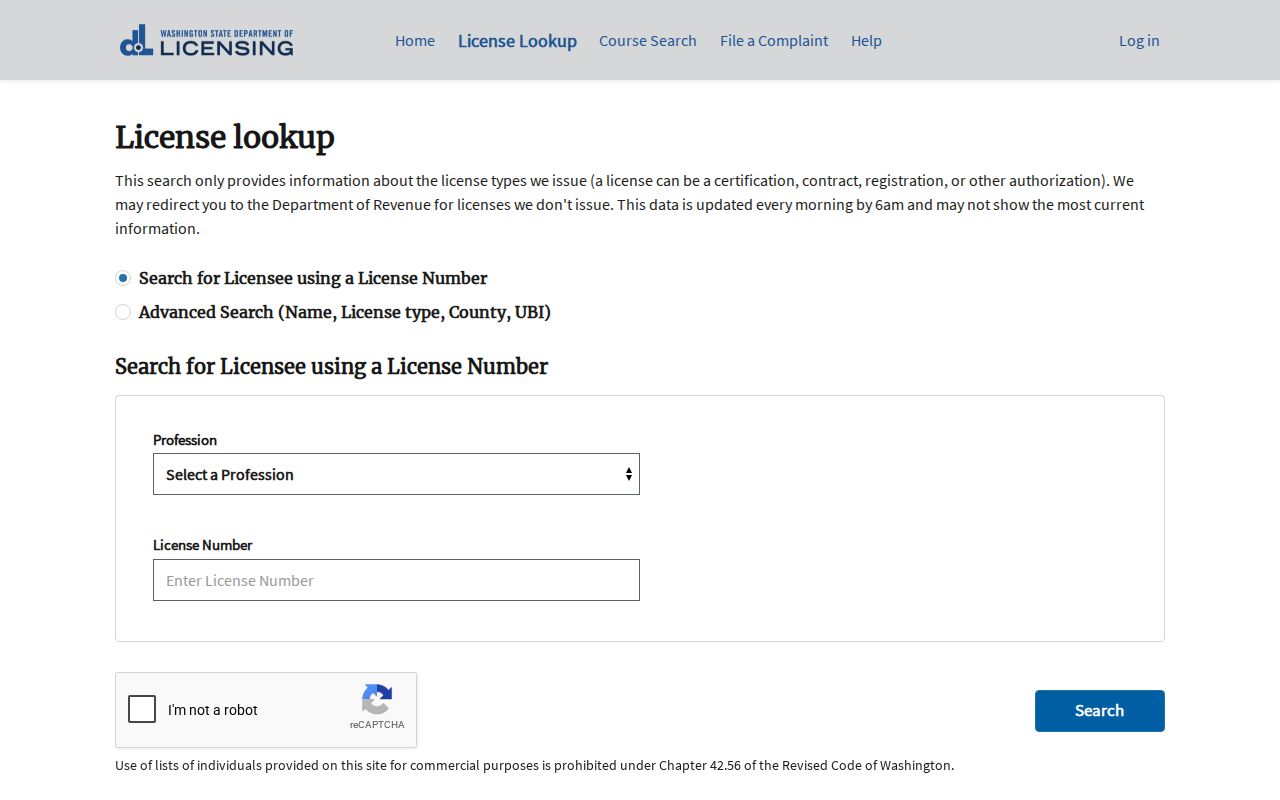
Use a name, license number, or credential type first, then verify current status with the responsible board.
Covington Business and Money Records
The Washington Corporations and Charities Filing System searches by business name or UBI. Advanced controls add entity type, status, formation dates, and registered-agent or governor names. A summary can show the legal name, status, entity type, formation date, agent, offices, governors, and filing history. Filed service addresses should not be treated as proof of a person’s home.
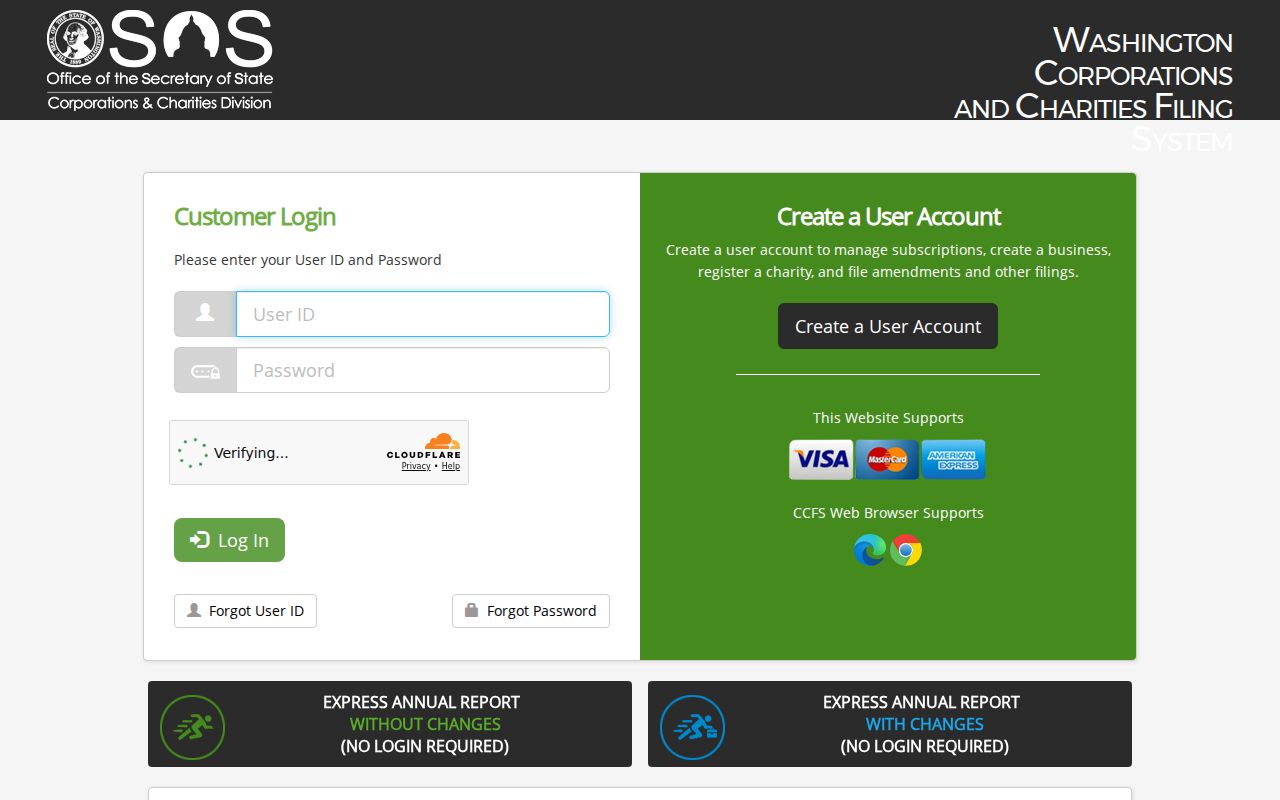
The CCFS result is useful for checking an official filing before paying a mailed demand. It is not automatically a certified copy.
The Washington Department of Revenue unclaimed-property search is another name-based state source. Searching is free, while a claim requires proof of ownership. Use the official custodian before paying a private finder or responding to a request for advance fees.
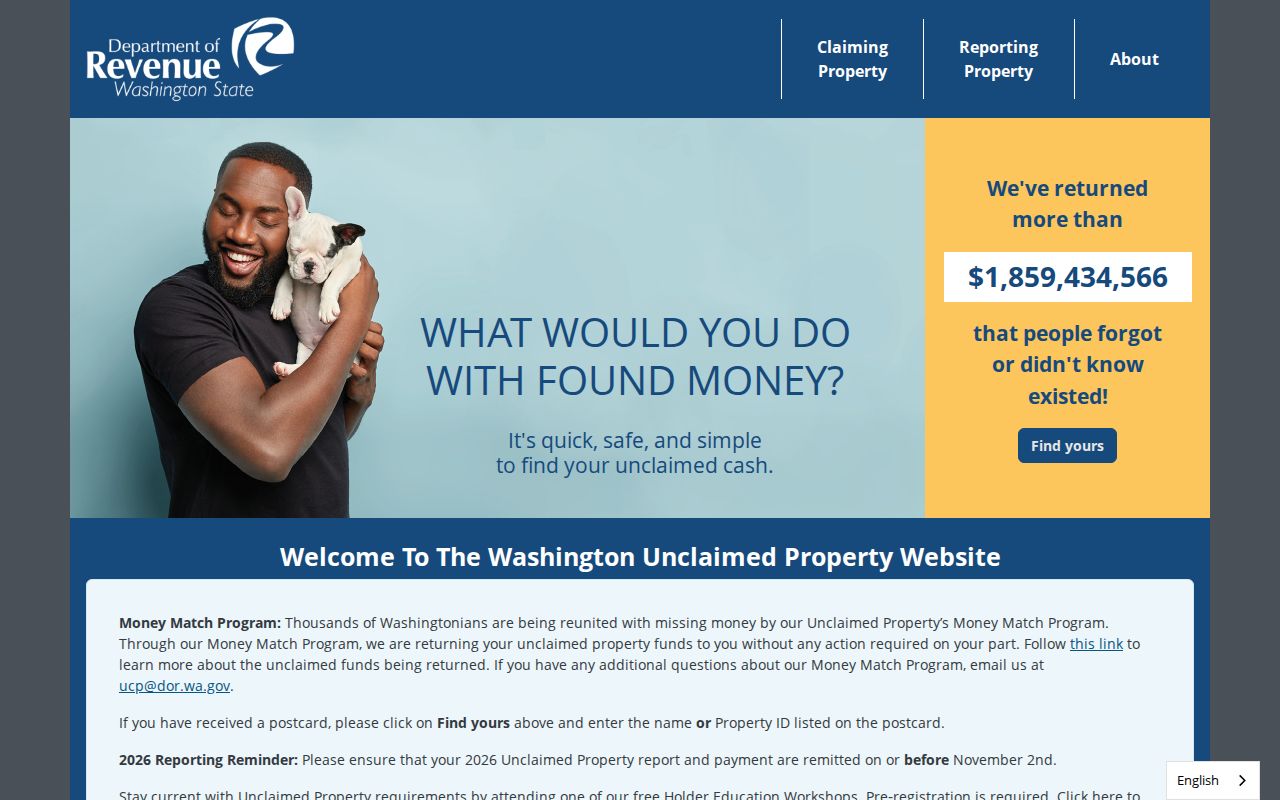
A match starts the verification process; it does not by itself prove that the property belongs to the searcher.
Covington Public Records Offices
Office geography is part of the Covington records system. City requests stay at City Hall. The Recorder, Superior Court Clerk, and Archives are in Seattle, while contracted district court service is associated with Kent. Call or check current counter hours before travel, especially when a record can be ordered by mail or online.
Covington City Clerk
16720 SE 271st Street, Suite 100
Covington, WA 98042
Fax: 253-480-2401
The Recorder counter is published for weekdays from 8:30 a.m. to 4:30 p.m., with recording ending at 3:30. Its phone copy line runs weekdays from 9 a.m. to 2 p.m. Archives offers phone and email help weekdays from 9 a.m. to 4 p.m., a walk-in lobby Tuesday and Wednesday from 10 a.m. to 3 p.m., and a research room by appointment.
Covington Record Copy Costs
Fees vary because each custodian sells a different product. Landmark searching and watermarked viewing are free. Recorder charges $1 per page for an uncertified recorded-document copy, or $3 for the first certified page plus $1 for each added page. A staff record search is $8 per hour. Online plain copies print at once; certified online orders are mailed within five business days to preserve the seal.
Superior Court Clerk fees published in the research are $0.50 per page for a plain copy, $5 for the first certified page plus $1 for each added page, and $9 for the first exemplified page plus $1 for each added page. An added seal costs $2. Archive retrieval, audio, and other products may add charges.
Under RCW 42.56.120, inspection and locating agency records are normally free. Where actual costs have not been calculated, default charges can include $0.15 per printed page, $0.10 per scanned page, $0.05 per four uploaded files, and $0.10 per gigabyte sent, plus media and postage. An agency may document a $2 flat fee, collect up to a 10 percent deposit, and bill installments.
Check before paying. Fees and office schedules can change. Ask for an estimate and verify the current schedule with the custodian that will produce the copy.
Request Covington Public Records
The Washington Public Records Act, chapter 42.56 RCW, applies to city and other executive-agency files. Ask for an identifiable existing record, not an answer to a question or a new compilation. Court case files follow court-access rules instead. A city request can cover council packets, ordinances, resolutions, contracts, board rosters, planning files, and correspondence that has not already been posted.
- Identify the right custodian and check its free index or published files. Save the exact case, instrument, parcel, permit, or license number.
- Describe the record type, subject, department, and narrow date range. State whether inspection or copies are wanted and name the preferred format.
- Submit through the correct portal, email, form, fax, mail, or counter. Keep the confirmation and respond promptly if clarification is requested.
- Within five business days, expect production or a specific link, an acknowledgement and estimate, a clarification request, or a written denial.
- Ask for segregable open portions, an exemption explanation, and a fee estimate. Use prompt agency review after a denial; court review is available after final action.
The Covington NextRequest portal provides the current online channel. The written city form may also be sent by email to jmichaud@covingtonwa.gov, fax, mail, or in person. It asks for requester contact data, a detailed record description, department and date information when known, inspection or copy choice, delivery preference, signature, and date.
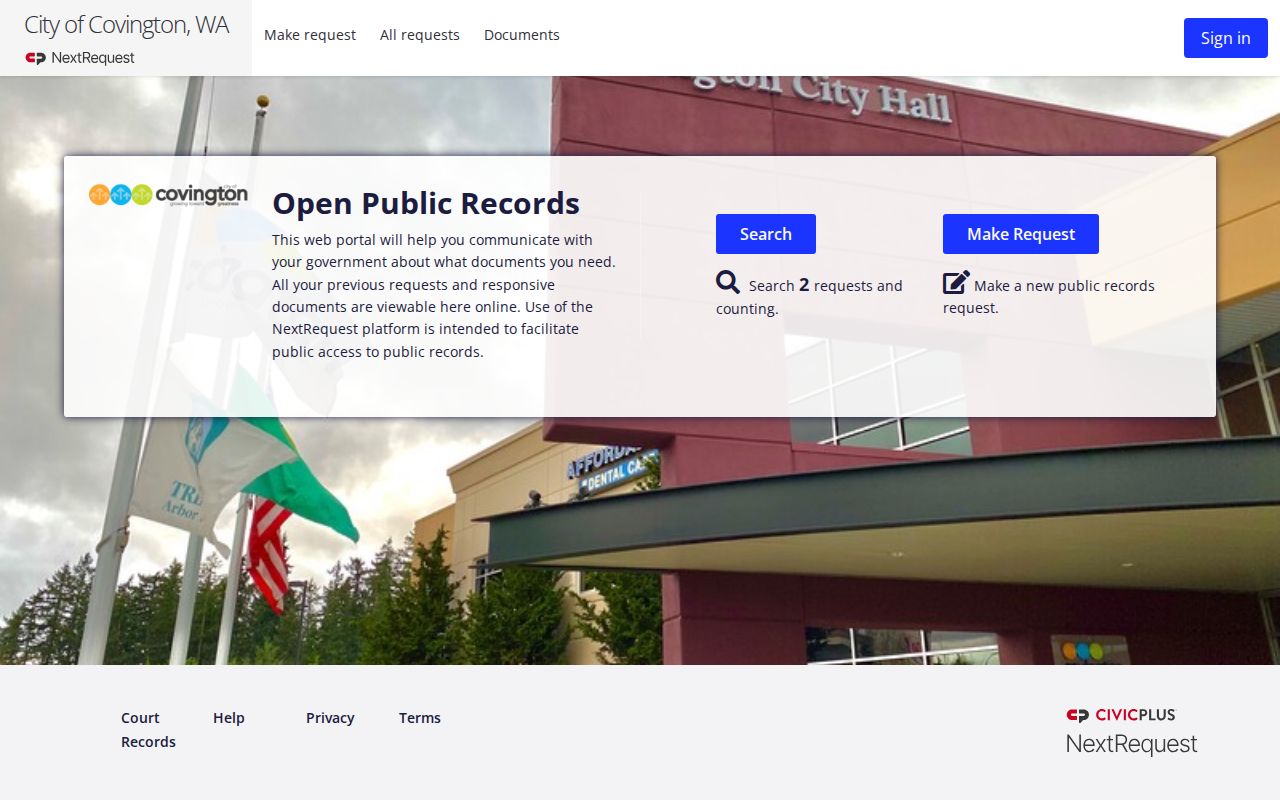
The portal is the city route only. A Covington Water District file requires that separate agency’s form, and a sheriff report routes to King County disclosure staff.
Lawful personal use. Public access does not permit stalking, harassment, threats, or attempts to uncover a protected address. Respect redactions and legal access limits.